Veja como o Actiz LIMS pode transformar seu laboratório
Peça uma demo
FISPQ Replaced by FDS: What You Need to Know
On July 3, 2023, the Brazilian Association of Technical Standards (ABNT) published the long-awaited update to Standard NBR 14725, replacing the former FISPQ (Chemical Product Safety Information Sheet) with the FDS (Safety Data Sheet).


On July 3, 2023, the Brazilian Association of Technical Standards (ABNT) published the long-awaited update to Standard NBR 14725, replacing the former FISPQ (Chemical Product Safety Information Sheet) with the FDS (Safety Data Sheet). This change brings several significant transformations to the Brazilian chemical industry.
In this article, we’ll break down the details of this update and provide guidance on the actions laboratories need to take to comply with the new regulation.
To understand the magnitude of this update, it’s worth noting that NBR 14725 is one of the most important regulations governing the safe handling and storage of chemical substances in laboratories here in Brazil. However, what makes this standard even more significant is its guidance on implementing the Globally Harmonized System of Classification and Labelling of Chemicals (GHS).
The chemical industry has evolved considerably over the years, with the discovery of new hazards and the development of new products. A comprehensive revision therefore became necessary to keep pace with these advances and ensure compliance with international safety standards.
What is FISPQ?
FISPQ stands for Ficha de Informações de Segurança de Produtos Químicos (Chemical Product Safety Information Sheet) — a standardized document covering the hazards, safe handling, storage, and emergency measures for a chemical substance or product. It was the format adopted in Brazil until the publication of NBR 14725:2023, when it was replaced by the FDS.
What is FDS?
FDS stands for Ficha de Dados de Segurança (Safety Data Sheet) — the document that replaced the FISPQ in Brazil following the NBR 14725 update in July 2023, aligned with the Globally Harmonized System (GHS) for the classification and labelling of chemicals. In practice, it serves the same function as the former FISPQ, with its structure and content updated to international safety standards.
Main changes introduced by the update
The updated standard introduced several significant changes affecting the chemical sector. Here are the main ones:
- The standard is now consolidated into a single part, making its content more comprehensive and extensive compared to the previous version, which was split into four parts.
- The new regulation is based on the seventh revision of the Purple Book, aligning and harmonizing it with the regulations of other countries that follow the GHS (Globally Harmonized System of Classification and Labelling of Chemicals).
- The standard is designed to facilitate the import and export of chemical products, which is why it was also based on European legislation.
- Two new hazard classes were added to the classification system: Desensitized Explosives and Hazardous to the Ozone Layer.
- Labelling elements were revised, with the addition of new H-statements (hazard statements) and P-statements (precautionary statements). Many existing statements also had their wording changed.
- New rules were added for labelling small packaging, improving hazard communication.
Impacts and compliance deadlines
It’s important to note that, as of July 2025, the traditional Ficha de Informações de Segurança de Produtos Químicos (FISPQ) ceases to exist.
As a result, all Safety Data Sheets (FDS) and labels will need to be reviewed and updated, since this change directly affects how the laboratory handles chemical products on a daily basis: storage, transport, handling, disposal, and even training.
The involvement of experts and stakeholders
The standard’s revision process was extensive and rigorous, involving field experts, industry representatives, regulatory bodies, and other stakeholders. The result is an updated standard that reflects best practices and the latest scientific knowledge. This new version of NBR 14725 brings numerous improvements and updates, ranging from the classification of substances and mixtures to hazard and precaution communication.
How companies can streamline the NBR 14725 update process
To ensure compliance with the requirements of the new standard, companies must prepare and take a number of steps. It’s essential to review and update documents such as Safety Data Sheets (FDS), adopt the new labelling practices, and train staff to understand and follow the new guidelines. Transitioning to a new regulation can bring challenges, but acting within the established deadline is critical.
In this context, technology can help, making this process much faster, simpler, and more dynamic.
Our Actiz system offers a document management module, enabling the review and update of documents such as Safety Data Sheets (FDS). It also allows safety and NFPA information to be updated directly in the system, along with label generation. To make things even easier, there’s a training module that helps staff understand these documents.
In addition, Actiz LIMS makes managing FDS much more practical and secure. Check out more details in this video with Vitor Moreira, Support Coordinator at Actiz:
By taking advantage of the solutions Actiz offers, laboratories can adapt efficiently and effectively, ensuring compliance and avoiding future issues. Schedule an Actiz LIMS demo.
Complete guide to the FISPQ-to-FDS transition: understand the changes and how to comply
The new version of the NBR 14725 standard mandates the replacement of the Ficha de Informações de Segurança de Produtos Químicos (FISPQ) with the Ficha de Dados de Segurança (FDS), effective July 2025. To help companies understand this transition and adapt to the requirements, we’ve put together a complete, free resource.
In this infographic, you’ll find:
- The key differences between the FISPQ and the new FDS
- What changes in practice under the new standard
- How a LIMS system can support compliance with the new requirements
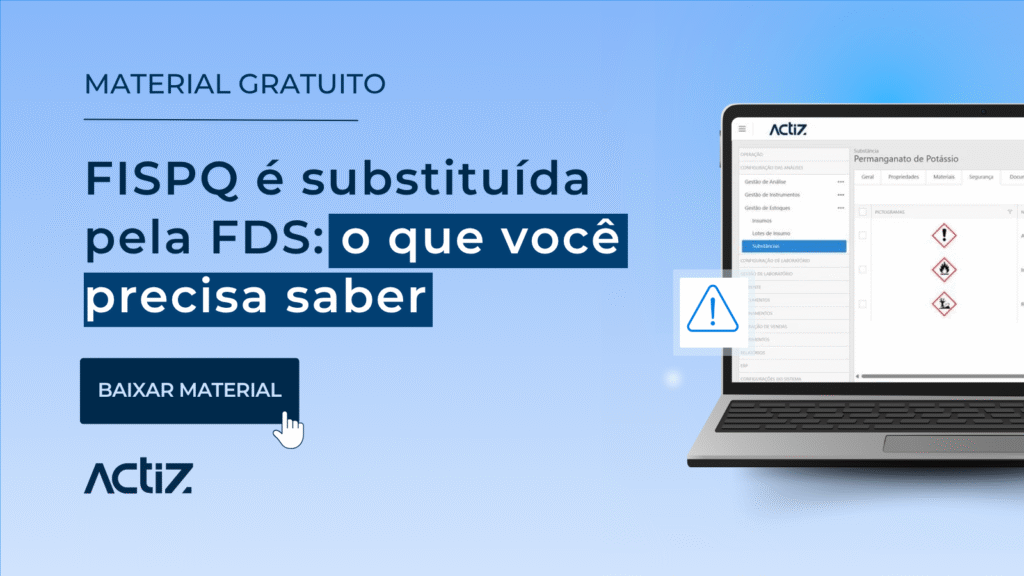
If your company still has questions about the transition or needs support structuring its update processes, this resource is essential.
Adopt the new NBR 14725 requirements with safety, efficiency, and compliance
The update to Standard NBR 14725 brings significant changes to chemical product safety. The replacement of the FISPQ with the FDS reflects the evolution of the chemical industry and aims to ensure compliance with international safety standards. These changes are intended to improve the classification, identification, labelling, and hazard communication of chemical products, promoting greater safety and harmonization across the sector.
Companies must prepare to comply with the new standard within the established deadline by reviewing and updating documents, adopting updated labelling practices, and training their teams.
You can access the updated ABNT NBR 14725 standard here: ABNT Catálogo.
With Actiz, you can adopt the new labelling practices and train your team to understand and follow the new guidelines. Take advantage of the solutions our system offers.
After the SDS is prepared, the challenge becomes the routine: see how to control versions and record what is sent to the customer.