


Veja como o Actiz LIMS pode transformar seu laboratório
Peça uma demo
LIMS and Sustainability: 7 Strategies
Discover 7 ways a LIMS helps laboratories cut costs, optimize resources, and efficiently meet sustainability targets.

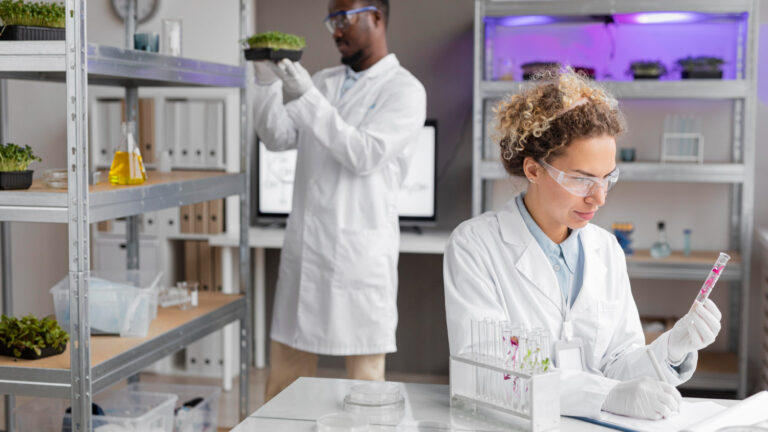
Pressure for sustainability, driven by the ESG (Environmental, Social and Governance) agenda, has never been higher — both from a regulatory and a market standpoint.
According to the United Nations Environment Programme (UNEP), research and quality control laboratories are among the highest per-capita consumers of energy and water in corporate settings, using up to 10 times more energy than a traditional office¹.
In addition, studies published by the American Chemical Society (ACS) indicate that laboratory waste can account for 5% to 10% of the total hazardous chemical waste generated by industry².
In this scenario, sustainability has stopped being a competitive differentiator and become a survival requirement. Adopting greener practices is now tied not only to cost reduction, but also to mitigating regulatory risk, improving talent retention, and strengthening brand value.
This is where Laboratory Information Management Systems (LIMS) take on a strategic role. More than tools for organizing data, modern LIMS platforms function as integrated digital ecosystems, capable of:
- Reducing consumable waste,
- Extending equipment service life,
- Digitizing critical processes,
- Managing waste with full traceability,
- Supporting compliance with international standards such as ISO 14001 (environmental management), ISO 17025 (laboratory competence), and GLP (Good Laboratory Practice) guidelines.
In this article, I’ll walk through, in practical terms, how a LIMS can transform the way industrial and research laboratories approach sustainability — not just as an ideal, but as a business intelligence strategy.
1. Resource use efficiency
Laboratories are high-consumption environments for reagents, energy, and water. Consider the sheer volume of resources consumed daily in a lab: energy for equipment running 24/7, water for glassware washing, expensive and often hazardous reagents, and a wide range of consumables.
The absence of proper controls generates waste, rework, and a larger environmental footprint.
A modern LIMS acts as a conductor, intelligently orchestrating the use of these resources. By centralizing and automating test scheduling, a LIMS reduces the need for repeat testing and ensures greater traceability.
In addition, inventory management prevents over-purchasing and the disposal of expired reagents, resulting in a smaller environmental footprint and greater financial efficiency.
2. Waste management with traceability
If resource-use efficiency is one pillar of sustainability, waste management is, without a doubt, its foundation.
In laboratories, we handle a wide range of materials, many of them hazardous, and improper disposal can have devastating consequences for the environment and public health. This is where intelligent automation — again, with the LIMS at the center — makes all the difference.
A LIMS makes it possible to log the generation, composition, and final disposition of each waste stream, ensuring full traceability and compliance with environmental regulations. Automation reduces human error, facilitates correct segregation, and enables safe recycling or disposal processes.
3. Equipment longevity through proactive maintenance
Laboratory equipment represents a significant investment. And like any investment, we want it to last as long as possible, right?
Equipment longevity isn’t just a financial matter; it’s an important pillar of sustainability. The longer a piece of equipment runs efficiently, the less need there is to replace it, which reduces the consumption of new resources and the generation of e-waste.
The key to that longevity is proactive maintenance. According to the US Department of Energy, proactive maintenance practices can extend laboratory equipment service life by up to 20%3.
It’s not about waiting for something to break before fixing it — it’s about anticipating problems and acting before they happen. So how does a LIMS fit into this equation?
A LIMS offers an excellent way to manage your laboratory equipment, ensuring continuous operation.
Instead of firefighting, a LIMS makes it possible to ensure equipment is always properly calibrated, receives adequate maintenance, and has its performance monitored appropriately over time.
A modern LIMS also saves considerable time, freeing lab professionals from most of the burden of equipment oversight.
It’s a virtuous cycle: the LIMS optimizes workflow, frees up staff time, which in turn allows better equipment care, extending its service life and contributing to a more sustainable and economically viable laboratory.
4. Digitalization and paper reduction
In an increasingly connected, digital world, I still see laboratories buried in stacks of paper: sample sheets, test reports, procedure manuals, logbook entries, raw data records, solution traceability records — all printed, filed, and often lost.
Beyond the obvious environmental impact of paper consumption, this reliance on physical records generates inefficiency, errors, and a disorganized work environment.
The shift to digital processes isn’t just a trend; it’s a necessity for any laboratory seeking to be both sustainable and competitive. And the LIMS is the driving force behind that transformation.
Process digitalization, enabled by a LIMS, centralizes all information in an electronic repository with full traceability. Beyond the significant reduction in paper use, this approach raises operational efficiency and record reliability.
A paperless laboratory is a more efficient, safer, and unquestionably more sustainable laboratory.
5. Social responsibility and working conditions
To me, sustainability goes well beyond the environmental dimension. It embraces the social one too, and that means taking care of the people who make the laboratory run. Our staff is the most valuable asset, and ensuring fair working conditions, a safe environment, and the promotion of their health and well-being is a non-negotiable responsibility.
A stressful work environment, with repetitive manual processes, task overload, and constant pressure for results, isn’t sustainable in the long run.
This is where digital tools — and, once again, the LIMS — play a crucial role.
With the automation a LIMS provides, bureaucratic activities are reduced and there’s greater focus on value-adding analytical work.
When a team feels valued, safe, and equipped with the right tools to do its job, productivity rises, turnover falls, and service quality improves.
Social responsibility, then, isn’t just a box to check on a compliance list; it’s an investment in human capital that drives the success and sustainability of the laboratory as a whole.
6. Cloud operations and carbon footprint reduction
A modern LIMS can run in the cloud, offering additional sustainability benefits. Cloud-based solutions allow for better resource utilization compared to on-premises systems, since computing capacity can scale to match demand. This optimizes energy use and avoids unnecessary resource consumption.
In addition, many cloud providers are now carbon-neutral, offsetting their emissions through renewable energy or CO2 offset projects.
Using a cloud-based LIMS can further reduce a laboratory’s carbon footprint.
7. Sustainability monitoring and reporting
Measuring indicators is fundamental to any sustainability strategy. A LIMS provides detailed reports on energy consumption, material use, waste generation, and compliance indicators.
This capability enables not only continuous process improvement, but also greater transparency with auditors, regulatory bodies, and stakeholders.
Conclusion
Resource-use efficiency, intelligent waste management, equipment longevity, process digitalization, and, fundamentally, care for the people who keep the wheel of SUSTAINABILITY turning.
For the planet, it’s a matter of survival. For the laboratory, it’s a matter of business intelligence.
Laboratories that embrace sustainability don’t just cut operating costs and minimize risk — they also strengthen their reputation, attract talent, and position themselves as leaders in an increasingly conscious market. It’s a powerful marketing driver, showing the world that their commitment extends beyond analytical results.
So my invitation to you is to look at sustainability not as a burden, but as an opportunity — an opportunity to innovate, to be more efficient, to take better care of your team, and to contribute to a greener, more prosperous future. The future of the laboratory is sustainable, and the LIMS is the path to get there.
References
- UNEP (United Nations Environment Programme). Greening Universities Toolkit: Transforming Universities into Green and Sustainable Campuses. 2014.
- American Chemical Society (ACS). Green Chemistry and Engineering in the Laboratory. 2020.
- US Department of Energy. Operations and Maintenance Best Practices Guide. 2010.
For a broader look at this topic, see our complete guide to sustainability and ESG in laboratories.


